
Focusing On The Conservation of Ecosystems, Habitats & Wildlife

Elephants Need Our Help To Survive

Tens Of Thousands of Elephants Were Killed Just Last Year. Elephants can’t protect themselves against sophisticated, well-armed poachers. They need protected areas to roam. well-equipped ecoguards and they need you!

Question:  How in the wild can we bring elephants back from the brink of extinction?

Answer:  Enforce laws that already exist to protect elephants from the devastating illegal ivory trade. Find the enforcement gaps that poachers exploit and close them.

226269_210601222306915_6943090_nConservationists from all over the world  are  debating that question as they gather in Bangkok for the 16th Meeting of the Convention on International Trade in Endangered Species of Wild Flora and Fauna (CITES).

Tell the U.S. delegation to CITES to help ensure that the international laws that can save elephants are enforced.

Click here to automatically sign this petition. If 35,000 signatures are reached, it will be hand delivered to delegates next week.

As a supporter of Wildlife Conservation Society, I implore you to address the dire plight of elephants at the 16th meeting of the Conference of the Parties to CITES. CITES data show that 2011 was the worst year for both African elephant slaughter as well as large ivory seizures since record keeping began, and that 2012 was just as bad.

Thank you,

JJ 


Battleground: Rhino Wars – Airs Tonight!

Beginning on Thursday, March 7, at 9 PM (ET/PT), Animal Planet will be embedded in Battleground: Rhino Wars, a three-part miniseries that documents this intense conflict that is centered on the worldwide commercial demand for rhino horns, an exotic commodity that’s more valuable than gold on the black market. 

rhino-wars-300

The miniseries reveals the conflict between blood-thirsty poachers and one of South Africa’s anti-poaching units, which has recruited armed forces to stop the illegal, lucrative trade of rhino horns. Cameras reveal a bloody war that these elite U.S. warriors find themselves fighting, in an area where both rhinos and people are being slaughtered with increasing regularity. 

For the full story, click here.             

Final Thoughts About The Tragedy At Project Survivals Cat Haven

My thought and prayers go out to Dianna Hanson’s family. I wish I would have met her.

I would like to offer my deepest sympathy to Dale Anderson and Wendy Wichelman-Debbas at Project Survival’s Cathaven. I know how much they care about their staff and how much they love their big cats. I’m thinking of you during this difficult time and sending you all lots of love.  I’m so sorry for your losses.

I hope that my efforts in discussing my experiences at Cat Haven with the media helped shed positive light on such a tragic situation.

Unfortunately, tragedies occur for whatever reason but LOVE for the people and the animals still has to prevail!

Now is the time to stand up for Cat Haven and help however you can. Click Here To Help.

Watch video below to learn more other notable causes like Soysambu Conservancy.

Soysambu works to sustain wildlife species, indigenous livestock and habitat; supports local conservation initiatives; facilitates neighboring development and educates the community in the value of flora and fauna in order to preserve the Rift Valley Ecosystem for future generations.

[vsw id=”uJHkwef6tMk” source=”youtube” width=”525″ height=”444″ autoplay=”no”]


Finally, First CITES Summit In 3 Years – 177 Countries Gather in Bangkok from March 3 – 14, 2013

March 1, 2013

CITES SUMMIT:  Conference of the Parties

Head of Convention of International Trade in Endangered Species (CITES) Wildlife says people and animals are at immediate risk from wildlife crime and a “clampdown must mirror war on drugs”.

CITES  meeting in Bangkok : Burning of Gabon's entire stockpile of illegal poached ivoryAccording to the Guardian, top wildlife officials said that crime syndicates and terrorists are outgunning those on the frontline of wildlife protection and pose a deadly threat to people and animals.

The law enforcement fightback must mirror the war against illegal drugs, said John Scanlon, secretary general of the Convention on International Trade in Endangered Species (Cites), with undercover operations and harsh penalties.

Note:  The global black market in animal and plants, sold as food, traditional medicines and exotic pets, is worth billions and sees an estimated 350 million specimens traded every year.

For the full story, click here.

International Polar Bear Day

February 27, 2013

SOS:  SAVE Our SEA Ice On International Polar Bear Day – February 27th

Inviting you to join me and Polar Bear International in celebrating it as a day of action to reduce your carbon footprint!

How?

By taking part in the Thermostat Challenge, the launch event for Polar Bear International’s Save Our Sea Ice (SOS! campaign), which is a series of carbon-reduction efforts to help save sea ice habitat.

ACT NOW &

………Take The Thermostat Challenge!

100 Most Endangered Species

“Do these species have a right to survive or do we have a right to drive them to extinction?” said Professor Jonathan Baillie of the Zoological Society of London (ZSL) in a press statement.

8,000 scientists identified the 100 most endangered animals, plants and fungi.

“All the species listed are unique and irreplaceable. If they vanish, no amount of money can bring them back,” said the report’s co-author Ellen Butcher, who is also from the ZSL. “However, if we take immediate action we can give them a fighting chance for survival.”

1. Hanging on: Pygmy three-toed sloth

There are less than 500 individual pygmy three-toed sloths left in the wild and are only found in on the Isla Escude de Veraguas, Panama.

2. Hainan gibbon

Found on Hainan island, China, conservationists believe less than 20 mature Hainan gibbons are still alive. Hunting has been the main reason for their perilous status as critically endangered.

3. Luristan newt

The Luristan newt is only found in three fast-flowing streams in the southern Zagros mountains in Iran. Their illegal collection for the pet trade has led to less than 1,000 mature individuals being left in the wild.

4. Spoon-billed sandpiper

Trapping and reclamation of its winter grounds has left the spoon-billed sandpiper on the brink of extinction. The global population is thought to be less than 100 breeding pairs.

5. Willow blister

The limited availability of habitat in Pembrokshire, Wales has lead to this fungi being one of the world’s most endangered.

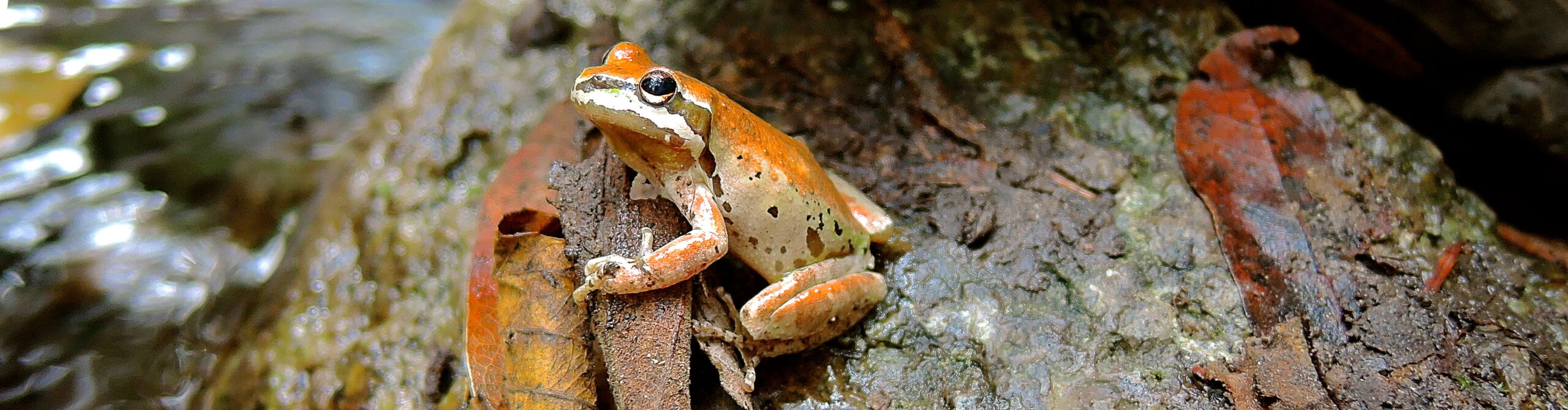
6. Archey’s frog

It is unknown how many Archey frogs are left in their natural habitat of the Coromandel peninsula and Whareorino Forest in New Zealand.

7. West Australian underground orchid

Around 95% of the West Australian underground orchid’s natural habitat has been destroyed leading to estimates than less than 100 exist in the wild.

8. Javan rhino

The Javan rhino was once found in forests across Southeast Asia, but today less than 100 remain in the Kulon National Park in Java. Their horns are prized in traditional medicine and can fetch up to $30,000 on the black market.

9. Hirola

Habitat loss, poaching and competition with livestock has left the wild Hirola population in dire straits. Less than 1,000 are left in southeast Kenya and southwest Somalia.

10. Dombeya mauritania

Found in Mauritius, destruction of its natural habitat and invasive species are pushing this plant to the brink of extinction.

11. Aci Gol toothcarp

A few hundred pairs of this small fish can be found only in small springs around Lake Aci in Turkey.

12. Seychelles sheath-tailed bat

Found in two small caves on Silhouette and Mahe, Seychelles, it is thought to be only up to 100 mature individuals of this rare bat species left.

13. Sumatran rhino

Less than 250 Sumatran rhino exist in the wild, and can be found in decreasing locations across Indonesia and Malaysia.


Huge Python Found In Everglades With 87 Eggs Inside

The recent discovery of the biggest Burmese python ever found in Florida is convincing evidence of just how well established these highly destructive reptiles have become in Everglades National Park and other parts of South Florida, according to Florida scientists.

The snake was 17 feet 7 inches (5.35 meters) long and weighed 164 1/2 pounds (76 kilograms). Scientists recovered 87 eggs from the snake also a record for the state. The pythons are surviving a long time in the wild, said snake expert Kenneth Krysko of the Florida Museum of Natural History. There’s nothing stopping them.

About 1,825 Burmese pythons were discovered in Everglades National Park from 2000 to 2011. However, scientists think the python population is many times higher.